REVIEW · SHANGHAI
2-Hour Chinese Calligraphy with an Artist in Shanghai, China
Book on Viator →Operated by InkMoon · Bookable on Viator
Brush, ink, and a calm Shanghai studio. This 2-hour workshop is interesting because you get a quick, in-English calligraphy history lesson first, then you practice with real tools and finish with a take-home souvenir. I love that everything is provided, so you can show up with zero prep. I also love the small-group feel, where the teacher, Lucie, can correct your brush movements as you go. The only real drawback is the location: it’s in a quieter lane, so you’ll want good directions to avoid a mini wander.
You also get more than a craft demo. You hear stories behind famous works, learn how different scripts work in practice, and then you write your own character for a traditional folding fan. Class times are flexible too, with options in the morning, afternoon, or evening, so you can slot it into a busy Shanghai day without stress.
And yes, there’s tea or coffee involved. That small break matters after museums and markets, because calligraphy is physical work. It asks for steady hands, good posture, and calm attention, not rush.
In This Review
- Key highlights before you go
- Chinese Calligraphy Workshop Flow: From Scripts to Your Folding Fan
- Chinese Calligraphy 101: What You Learn Before You Pick Up the Brush
- Tools of the Trade: Brushes, Ink, Paper, and Real Technique
- Warm-Up Practice That Builds the Right Habits
- Your Final Piece: Writing a Favorite Character on a Traditional Fan
- Tea or Coffee Pause in the Studio: A Shanghai Reset
- Where to Meet Near Jing’an Temple (and How to Actually Find It)
- Price and Value: Why $50 Makes Sense Here
- Who This Chinese Calligraphy Class Is Best For
- My take: Should you book this calligraphy workshop?
- FAQ
- How long is the Chinese calligraphy workshop?
- How much does it cost?
- Is the workshop taught in English?
- What will I make at the end of the class?
- What’s included in the price?
- How many people are in a group?
- Where is the meeting point?
- Can I choose a class time?
- What is the cancellation policy?
- Are service animals allowed?
Key highlights before you go
- Small group of up to 8 means Lucie can actually watch your strokes and adjust your grip
- English instruction keeps the technique clear even if you know zero Chinese calligraphy
- All tools and materials included, so you don’t have to source brush, ink, or paper in advance
- History + technique, not just hands-on, with an intro to Chinese scripts and why they matter
- A traditional folding fan souvenir lets you take home something personal, not just a photo
Chinese Calligraphy Workshop Flow: From Scripts to Your Folding Fan
This class runs about 2 hours. You’ll start with a short introduction to the art of Chinese calligraphy, then move into practical technique, and end by creating a finished piece you can take home. The rhythm is simple: learn a point, practice it right away, then level up into your final artwork.
It’s set up for beginners, including people who feel a bit intimidated by brushwork. The goal is not perfection. The goal is control. By the time you finish, you should feel like you understand what makes a stroke look right, and you’ll have a fan with your character on it to prove it.
You can also read our reviews of more tours and experiences in Shanghai.



Chinese Calligraphy 101: What You Learn Before You Pick Up the Brush
Before ink hits paper, you get a brief overview of Chinese calligraphy and how Chinese people think about the art. You’ll also hear stories behind great works and see examples that help you understand what you’re trying to reproduce.
One of the most useful parts is learning the basics of scripts. You don’t need to memorize terms, but you do need a sense of how writing styles differ in practice. Lucie explains things in a way that clicks fast, especially if you’re the type who needs a reason, not just a rule.
Here’s what I like about this “101” stage: it frames calligraphy as art, not just writing. Once you get that, you stop fighting the brush and start cooperating with it. Your strokes begin to look less random because you know what you’re aiming for.
Tools of the Trade: Brushes, Ink, Paper, and Real Technique
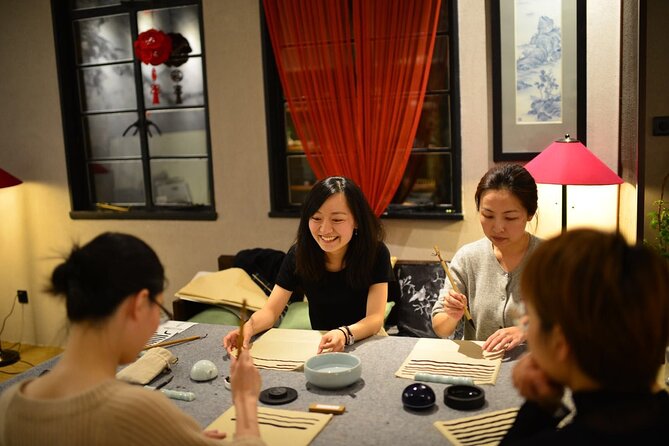
A big reason this is a good value is that you don’t have to play supply hunt. The class includes the tools and materials, plus the instruction to use them correctly.
You’ll learn about the writing tools that have been used for about a thousand years, and you’ll practice with the same kind of brush-and-ink approach that makes calligraphy feel different from pen work. Ink behaves fast. That surprises some first-timers. One minute you’re dipping the brush, the next minute the ink has already started doing its thing on the paper.
So the early technique matters:
- how you hold the brush and control pressure
- how to plan the movement before you commit
- how not to panic when a stroke looks rough at first
The small-group size helps here. Lucie can give specific corrections in the moment, not generic advice you forget 10 seconds later. You’ll also get a clear feel for what makes strokes crisp versus muddy, which is the difference between a souvenir and something you’re proud to display.
Warm-Up Practice That Builds the Right Habits
After the intro and tool basics, you move into warm-up practice. This part is short, but it’s where beginners either lose confidence or gain it quickly. The class is structured to get you comfortable with basic writing technique before you tackle the final piece.
In practice, warm-ups help you:
- get used to the way the brush glides
- learn the rhythm of short strokes and how they connect
- understand how mistakes happen and how to recover without restarting your whole mindset
I also like that the warm-up sets expectations. You learn that ink flow and brush movement are connected, so you can’t just copy shapes blindly. You need the motion. Once you do a few attempts, things start to feel less like guesswork.
And because the group is capped at 8, you’re not stuck watching others. You’re practicing. You might even have enough time to try a stroke again after Lucie tweaks your form.
Your Final Piece: Writing a Favorite Character on a Traditional Fan
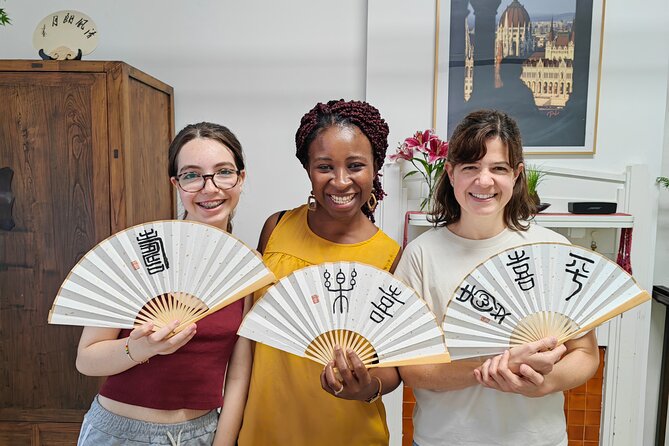
The best part is the finish. You create your own artwork: a traditional folding fan decorated with Chinese calligraphy. You choose a character you like, then write it in the style you’ve been practicing during class.
This is also where the class becomes personal. It’s not a generic worksheet. It’s your character, your brush control, your final composition. In the last stage, Lucie helps refine your technique so your finished piece looks like calligraphy rather than just ink on paper.
A note worth mentioning for people who are a bit picky about style: one learner asked for a specific script preference and Lucie adapted the approach. So if you care about the look of the handwriting style—like regular script versus seal-style options—it’s worth bringing that up.
When you’re done, you leave with a real souvenir you can use later. A fan feels practical in Shanghai heat, and it also feels meaningful because you made it stroke by stroke.






Tea or Coffee Pause in the Studio: A Shanghai Reset
You’re not just learning in theory. The class includes tea or coffee, which makes the whole experience feel like a proper cultural session, not a rushed activity between two bus stops.
The tone in the studio tends to be calm and focused. Calligraphy takes concentration. If your day in Shanghai has been museum-heavy or shopping-heavy, this is a great counterweight. It gives your brain a different job: slow down, watch your hand, and enjoy the physical feedback of the brush and ink.
If you like your cultural activities hands-on (and you’re tired of only looking), this format works. You’ll walk out with something to show, not just memories to talk about later.
Where to Meet Near Jing’an Temple (and How to Actually Find It)
The meeting point is Yugucun (North Gate), in the Jing’an area, near Yu Yuan Lu. The address listed is 361弄3-127号, 邮政编码 200040.
A few practical points:
- The studio is described as being off the main tourist path, so give yourself extra time the first time you try to find it.
- You’re near public transportation, and people generally use the Jing’an Temple area as a reference point.
- The lane-style address can feel confusing on arrival, so follow the directions you’re given closely.
My best advice is simple: plan to arrive early, and don’t treat the first look at the area like it’s “the place.” In places like this, the right door is often the third turn off a main road. House numbers get marked, but only if you’re in the correct lane.
Price and Value: Why $50 Makes Sense Here
At $50 per person for about 2 hours, this isn’t trying to compete with big-ticket luxury experiences. It competes with the idea of paying for a “thing” versus paying for instruction plus materials.
Here’s what you’re really paying for:
- English instruction from an actual artist-teacher (Lucie)
- all tools and materials included
- a structured flow from history and scripts to practice
- a finished take-home artwork (your folding fan)
- small-group attention, capped at 8
Compared with many activities that are mainly watching, this one is learning + making. You leave with tangible proof of the lesson. And because the class includes the supplies, there’s no hidden cost for ink, brushes, or paper.
So if you’re the type who likes to spend money on experiences you can show later, it’s a solid deal.
Who This Chinese Calligraphy Class Is Best For
This class suits beginners best. If you can write your name with a pen, you can learn calligraphy basics, as long as you’re willing to slow down and practice short strokes.
It’s also great for:
- couples who want a shared activity that’s not just dining
- solo travelers who want a calmer change from sightseeing
- people who like culture that’s tactile, not only visual
One reason families may like it: the instruction is interactive and supportive, and the format works for kids who can follow simple guidance. If you’re traveling with children, it helps to bring patience, since brush control takes time.
And if you’re the kind of traveler who loves learning a cultural skill you can carry home, you’ll probably get a lot out of the history stage too. It changes how you see Chinese writing on signs and in museums afterward.
My take: Should you book this calligraphy workshop?
Yes, you should book it if you want a real skill in a short time and you care about leaving with something personal. The combination of English teaching, small-group attention, and a finished folding fan makes it a high-satisfaction format for a mid-trip break.
Skip it only if you’re looking for a long, museum-style history program or if you dislike studio settings and want purely outdoor sightseeing. This is a hands-and-mind activity. If that sounds like your kind of fun, it’s an easy choice.
FAQ
How long is the Chinese calligraphy workshop?
It lasts about 2 hours.
How much does it cost?
The price is $50.00 per person.
Is the workshop taught in English?
Yes, the workshop is conducted in English.
What will I make at the end of the class?
You create a traditional folding fan decorated with Chinese calligraphy. The class focuses on writing a character as your final artwork.
What’s included in the price?
All tools, materials, instruction are included, along with tea or coffee.
How many people are in a group?
The workshop has a maximum of 8 travelers.
Where is the meeting point?
You meet at Yugucun (North Gate), Yu Yuan Lu area, address listed as 361弄3-127号, 200040.
Can I choose a class time?
Yes. You can choose from morning, afternoon, or evening class times.
What is the cancellation policy?
Free cancellation is available up to 24 hours in advance for a full refund. If you cancel less than 24 hours before the start time, the amount paid is not refunded.
Are service animals allowed?
Yes, service animals are allowed.