REVIEW · BEIJING
Noon Calligraphy Class
Book on Viator →Operated by Hutong Calligraphy Class · Bookable on Viator
Ink on paper feels like quiet magic. This is a hands-on Chinese calligraphy class in downtown Beijing, led by an art teacher, with time to ask questions and practice your strokes. I especially like the calm, structured pacing and the chance to produce a finished piece that you can keep, even if you’re a total beginner. The main thing to consider is that it’s short, so you won’t leave fluent, just confidently started.
You’ll pick from multiple daily class times, which makes it an easy fit when you want a break from sightseeing—especially if you’re in the Wangfujing area anyway. The class also leans into meaning, not just motion: you’ll learn how tools and strokes connect to Chinese culture through rhythm and focus. One downside is that since the group is capped at 15, the instructor’s attention is shared, not one-on-one.
In This Review
- Key Points That Make This Beijing Calligraphy Class Worth Your Time
- What You’re Really Doing in a Beijing Calligraphy Class
- Noon Timing, Class Length, and Why It Matters
- Starting at Hilton Wangfujing and Re-centering Your Day
- Getting to the Hutong Calligraphy Spot in Central Beijing
- Your Art Teacher, Clear Instruction, and Real Q&A
- Tools and Technique: Brushes, Rice Paper, and Ink Stones
- The Stroke-by-Stroke Calm That People Come Back For
- Seal Carving and the Meaning Behind What You Write
- Group Size, Pacing, and Finishing a Take-Home Piece
- Price and Value: What $20 Buys You in Beijing
- Who This Class Fits Best (and Who Might Skip It)
- Should You Book This Noon Calligraphy Class in Beijing?
- FAQ
- How long is the calligraphy class?
- Where do I meet for the class?
- Where is the calligraphy class located?
- What’s included with the ticket?
- Is this class good for beginners?
- Can children join?
- How big is the group?
- Is there free cancellation?
Key Points That Make This Beijing Calligraphy Class Worth Your Time
- Small group size (max 15) keeps the lesson from feeling rushed
- Included supplies mean you practice right away with the right materials
- Teacher-led Q&A so you can ask about strokes, tools, and meaning
- Practice time before your final piece so you don’t feel thrown in at the end
- Seal carving basics add a classic cultural layer beyond the character-writing
- Relaxing mood that many people describe as almost meditative
What You’re Really Doing in a Beijing Calligraphy Class
A calligraphy class in Beijing isn’t just about copying letters. It’s about learning how Chinese writing works as an art form, where brush pressure, stroke direction, and timing matter as much as the final shape.
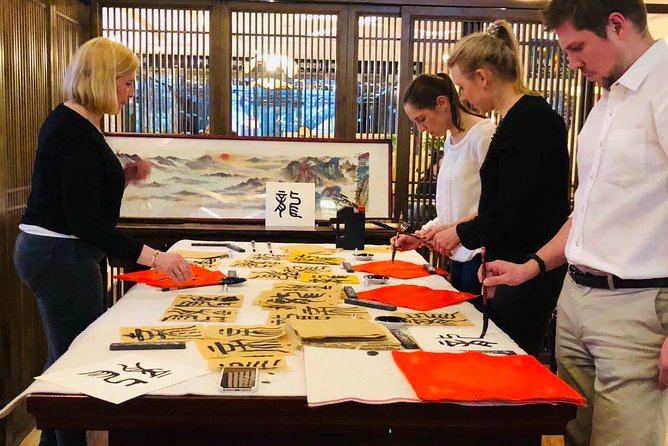
In this class, you’ll get guided instruction on the building blocks: brushes, ink, rice paper, and ink stones. You’re also introduced to the idea of writing as a physical expression of language—something you feel in your hand, not just something you look at.
You can also read our reviews of more tours and experiences in Beijing.

Noon Timing, Class Length, and Why It Matters
This is marketed as a noon calligraphy experience, but the smart part is flexibility: you can choose from multiple daily class times to match your day. That matters in Beijing, where your “best time to do things” often changes with traffic, weather, and energy levels.
You can also choose the length of the class when you book: there are 30-minute, 1-hour, and 1.5-hour options listed as available. If you want the most practice (and the best chance to feel proud of what you finish), the longer sessions are usually the better bet.
Starting at Hilton Wangfujing and Re-centering Your Day
The meeting point is Hilton Beijing Wangfujing in Dongcheng District, near Wangfujing Dongjie. You’ll meet there, do the class, and the activity ends back at the same meeting point—so you’re not stuck figuring out your return.
This setup is practical if you’re already sightseeing around central Beijing. It also makes the day feel calmer: you plan one contained activity rather than another open-ended “go find it” stop.
Getting to the Hutong Calligraphy Spot in Central Beijing
The class location is in downtown Beijing at No. 8 Wangfujing Dongjie, Dongcheng District. That’s a big deal for value because it reduces the friction of getting to the activity in a city where travel time can quietly eat your day.
The venue is associated with a hutong calligraphy experience, but the practical takeaway is simple: you’re combining a classic cultural craft with a central location. You don’t have to trade convenience for authenticity.
Your Art Teacher, Clear Instruction, and Real Q&A
This class is led by an art teacher who encourages questions. That doesn’t sound dramatic, but it changes everything—especially when you’re trying to understand stroke order, brush angles, and how to correct mistakes.
In the instruction you’ll hear names like Richard and Li tied to past sessions, and both appear in feedback as kind, informative, and patient. Even if your own teacher isn’t one of those names, the teaching style comes through consistently: clear explanations and supportive guidance.


Tools and Technique: Brushes, Rice Paper, and Ink Stones
Calligraphy looks easy on posters. It isn’t. The learning curve is real, but that’s also why it’s so satisfying when it starts to click.
You’ll work with the core materials: brushes, rice paper, and ink (including ink stones as part of the traditional tool set described). You’ll get practice with how ink behaves on paper and how different pressure changes the look of a stroke.
If you’ve never used a brush, treat the first attempts like warm-up, not final work. The class structure is designed so you practice more than you worry—then you move toward a finished character or piece.
The Stroke-by-Stroke Calm That People Come Back For
A common theme in feedback is that the class feels calming—like focused “morning reset,” even when the day is busy. People describe the motion of writing as relaxing and meditative, mainly because you’re doing one thing at a time with attention to breath and movement.
That doesn’t mean it’s quiet in a boring way. It’s usually light-hearted at the start, then more settled once everyone starts writing. For you, this translates to a rare Beijing experience that doesn’t rely on crowds, lines, or constant decision-making.
Seal Carving and the Meaning Behind What You Write
You’ll also get exposure to seal carvings, which is one of the classic ways calligraphers finish and personalize their work. Even a short intro to seals helps you understand that calligraphy isn’t only about characters—it’s part of a whole cultural system of writing, art, and identity.
Just as important, the lesson connects strokes to meaning. Some instruction emphasizes the deeper ideas behind the words you’re writing, not just the shapes. If you care about culture (not only souvenirs), this part is where the class becomes more than a craft.
Group Size, Pacing, and Finishing a Take-Home Piece
With a maximum of 15 travelers, you’re in a small group environment. That helps because you’re more likely to get your specific questions answered, and the instructor can correct visible issues without everyone waiting forever.
Another praised element is the time spent practicing before the final piece. That’s practical. It means you’re not relying on one lucky attempt; you learn what to adjust, then apply it when it counts.
Many people also mention that they got a final piece to take home. Even if your result isn’t perfect (because perfection isn’t the goal here), you leave with something tangible: proof you learned a new skill with your own hand.
Price and Value: What $20 Buys You in Beijing
At $20 per person, this is one of the more budget-friendly cultural workshops in central Beijing—especially because supplies and instruction are included. You’re paying for an art teacher, guided practice time, and the materials you need to actually make something.
The value improves if you choose a longer session, since you get more writing time and more chances to feel comfortable with the brush. It also improves if you’re traveling with someone else, since the offering notes group discounts.
One caution: because the class is short, your “value feeling” depends on your expectations. If you want deep mastery of calligraphy, you’ll likely need longer practice after the lesson. If you want a strong introduction with a finished keepsake, the price fits the outcome.
Who This Class Fits Best (and Who Might Skip It)
This class is great for:
- First-time learners who want a clear starting point
- People who like hands-on crafts with cultural context
- Travelers who want a calm indoor activity in Beijing
- Families, since children can participate as long as they’re accompanied by an adult
You might reconsider if you’re the kind of traveler who wants lots of walking, a long “tour” feel, or a major sightseeing stop. This experience is about the class itself. You’re choosing focused learning over broad urban coverage.
It’s also a good choice if you’re curious about Mandarin-adjacent learning. Some feedback points out that the class helps people stay engaged with the language through writing, which is a smart way to practice without pressure.
Should You Book This Noon Calligraphy Class in Beijing?
Yes, if your goal is a short, meaningful cultural workshop with hands-on instruction, included supplies, and a small-group vibe near Wangfujing. I’d especially recommend it if you like activities where your brain slows down and your hands do the work—because calligraphy is as much about focus as it is about skill.
Book it with the right expectation: you’re not leaving as a calligrapher. You are leaving with better control of brush strokes, a calmer mindset, and a real keepsake from Beijing.
FAQ
How long is the calligraphy class?
The experience is listed as about 1 hour, and the booking options include class lengths of 30 minutes, 1 hour, or 1.5 hours.
Where do I meet for the class?
You meet at Hilton Beijing Wangfujing (Wangfujing Dongjie, Dongcheng District, Beijing).
Where is the calligraphy class located?
The class location is listed at No. 8 Wangfujing Dongjie, Dongcheng District, Beijing, China.
What’s included with the ticket?
The ticket includes the calligraphy class (with the class length you choose), an excellent art teacher, and calligraphy supplies to use during the class.
Is this class good for beginners?
The activity notes that most travelers can participate, so it’s designed to be approachable even if you’ve never tried calligraphy before.
Can children join?
Yes, but children must be accompanied by an adult.
How big is the group?
The class has a maximum group size of 15 travelers.
Is there free cancellation?
Yes. You can cancel for a full refund up to 24 hours in advance of the experience’s start time.